





Toothpaste Tablets vs Traditional Toothpaste: Which Is Better?
Last updated: 26 October 2026
Toothpaste tablets have moved from niche eco-product to a mainstream alternative over the past few years. But if you’re unfamiliar with how they work, it’s fair to ask whether they’re actually as good as the tube toothpaste you already use.
This guide explains how toothpaste tablets work, how they compare with traditional toothpaste on cleaning, fluoride, packaging and convenience, and how four UK options compare: Smile Science, Pärla, Denttabs and Georganics.
Quick AnswerToothpaste tablets clean teeth in the same basic way as paste, and they offer real advantages in packaging, travel and pre-measured dosing. The thing to check is fluoride. The NHS says adults should use a toothpaste with at least 1,350ppm fluoride, and some tablets contain less than that or none at all. Check the ppm on the pack before you switch.
How Toothpaste Tablets Work
Toothpaste tablets are chewable, pre-measured doses of toothpaste in solid form. You place one tablet in your mouth, chew it until it turns into a paste, then brush with a damp toothbrush for the time stated on the pack, usually two minutes. The difference is format. Tube toothpaste is a water-based paste, while a tablet is dry and only turns to paste when it meets saliva. The cleaning action still comes from the same things: mild abrasives lift surface deposits, and fluoride (where included) helps protect against decay.Do Tablets Clean as Well as Paste?
Cleaning depends on the formula, not the format. What matters is how abrasive the toothpaste is, whether it contains fluoride and how much, and how well you brush. We aren’t aware of independent head-to-head trials that we can cite here, so we can’t say tablets clean better or worse than paste as a category. A well-made tablet and a well-made paste with the same fluoride level should do the same job.Toothpaste Tablets vs Traditional Toothpaste: The Core Differences
| Feature | Toothpaste Tablets | Traditional Toothpaste |
|---|---|---|
| Format | Solid, chewable tablet | Paste in a tube |
| Fluoride | Varies a lot: some about 1,450ppm, some lower, some fluoride-free | Standard in most; check the ppm |
| Packaging | Pouch, jar or tin, depending on brand | Plastic tube, often hard to recycle |
| Travel | No paste, so no liquid limits in hand luggage | Subject to liquid limits |
| Dose | Pre-measured, one tablet per use | User-determined amount |
| Habit | Chew first, then brush | Squeeze and brush |
| Availability | Mostly online and in health stores | Every supermarket and pharmacy |
Toothpaste Tablets Compared
Product details below come from Smile Science’s own product safety reports and retailer listings for the other brands (Bower Collective and Ocado for Pärla, Ecco Verde for Denttabs, Ethical Superstore for Georganics), last checked on 26 October 2026. Every claim in the last column is the brand’s own wording. Formulations change, so check the pack. The order is not a ranking, and we sell the first products.| Tablets | Fluoride | Key Ingredients | Brand’s Claims |
|---|---|---|---|
| Smile Science Complete Protection | Up to about 450ppm (sodium fluoride 0.1% or less) | Gum arabic, xylitol, tricalcium phosphate, sodium bicarbonate, aloe vera | Vegan, cruelty-free |
| Smile Science Sensitive | About 226ppm (sodium fluoride 0.05%) | Spilanthes acmella, aloe vera, sodium bicarbonate | Designed for sensitive teeth |
| Pärla Original | 1450ppm (sodium monofluorophosphate) | Calcium carbonate, kaolin, sodium bicarbonate, hydrated silica | “Naturally whitening”; plastic-free glass jar |
| Pärla Pro Sensitive | 1450ppm (sodium monofluorophosphate) | Potassium citrate, hydroxyapatite, calcium carbonate, hydrated silica | “Helps reduce sensitivity while protecting and strengthening teeth” |
| Denttabs Stevia-Mint with Fluoride | 1450ppm (sodium fluoride; spec table says 1,350 to 1,500ppm) | Microcrystalline cellulose, sodium bicarbonate, silica | “Effective protection against plaque and cavities”; listed RDA of 20 to 40 |
| Georganics Peppermint | None (fluoride-free) | Sodium bicarbonate, calcium carbonate, kaolin, peppermint oil | “Natural, organic and eco-friendly”; glass jar packaging |
The Toothpaste Tablets Reviewed
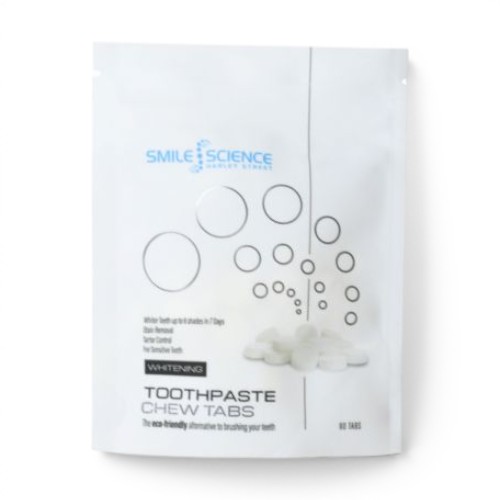
Smile Science Toothpaste Tablets — Complete, Sensitive and Whitening
Full disclosure: these are our own products, so read this section with that in mind. Where they excel A range of three formulas for different needs: everyday protection, sensitive teeth and whitening. The tablets are vegan, cruelty-free and packaged in pouches instead of plastic tubes. The formulas include xylitol and aloe vera, and the Sensitive tablets are built around Spilanthes acmella, a plant traditionally used for toothache. Worth knowing They contain fluoride (about 226ppm in the Sensitive tablets and up to about 450ppm in the Complete tablets), and the NHS recommends 1,350ppm for adults. Best for People who want a lower-plastic daily option with a formula for their specific need, alongside a fluoride toothpaste. View Complete Protection TabletsPärla Original and Pro — Fluoride and a Reusable Glass Jar
Pärla sells its tablets in a reusable glass jar with refill pouches. The Original is described as “naturally whitening”, and the Pro adds potassium citrate and hydroxyapatite with a claim that it “helps reduce sensitivity while protecting and strengthening teeth”. Where it excels Fluoride at 1450ppm, in line with the NHS’s 1,350ppm for adults, and plastic-free packaging, according to the listings. Directions are to chew for about 5 seconds, brush for 2 minutes and spit without rinsing. Where it falls short Both list calcium carbonate as an ingredient and give no abrasivity (RDA) figure. The Pro page claims it “strengthens enamel by 65%”, but it doesn’t show the study behind it. Best for People who want a fluoride tablet at a standard fluoride level in plastic-free packaging.Denttabs Stevia-Mint with Fluoride — Fluoride and Low Abrasion
Denttabs describes its tablets as gently polishing teeth to prevent discolouration, with “effective protection against plaque and cavities”. The retailer listing says it contains 1450ppm fluoride and lists a low abrasivity of 20 to 40 RDA. Where it excels Fluoride at about the level the NHS recommends, a published abrasivity range, and a compostable cornstarch bag, according to the listing. Where it falls short The listing’s spec table gives a fluoride range of 1,350 to 1,500ppm while a Q&A gives 1450ppm, so check the pack. It makes no sensitivity claims, and the directions say to chew and then brush for 3 minutes with a soft toothbrush. Best for People who want a fluoride tablet with a low listed abrasivity.Georganics Peppermint Tooth Tablets — Fluoride-Free and Natural
Georganics describes its tablets as natural, organic and eco-friendly, in a glass jar with an aluminium lid. They are vegan, PETA-certified and made in the UK, according to the listing. Where it excels Plastic-free packaging and a short, natural-style ingredient list. Where it falls short It is fluoride-free, so it doesn’t give the decay protection of a fluoride toothpaste. It lists calcium carbonate and kaolin as abrasives and gives no abrasivity (RDA) figure. Best for People who prioritise plastic-free packaging and are getting fluoride elsewhere, as advised by their dentist.Where Tablets Have the Advantage
Packaging
Toothpaste tubes combine several materials and are often hard to recycle. Tablets typically use less plastic, though the packaging varies by brand (pouch, tin or glass jar), so check each brand’s recycling instructions.Travel
Tablets contain no paste, so they aren’t subject to the liquid limits for hand luggage, and a month’s supply fits in a small pouch.Pre-Measured Dosing
One tablet is one use. There’s no guessing how much to squeeze, and it’s easy to see when you need to reorder.Where Traditional Toothpaste Has the Advantage
Fluoride Certainty
Most tube toothpastes state their fluoride in ppm and sit at or above the NHS’s 1,350ppm for adults. With tablets, the range is much wider, so you need to check.Familiarity and Availability
Squeezing paste onto a brush is an ingrained habit, and tube toothpaste is stocked everywhere. The chew-first step of a tablet takes a few days to feel natural.Children
Tablets are generally not recommended for young children, because the chewing step needs coordination and a whole tablet is a swallowing risk. Always check the product’s age guidance and follow NHS advice for children.Check the Fluoride
The NHS says adults should use a toothpaste with at least 1,350ppm fluoride to protect against decay, and to spit out rather than rinse after brushing. If you use a fluoride-free or lower-fluoride tablet, talk to your dentist about how you’ll get enough fluoride, for example by using a fluoride toothpaste at one brushing a day.Who Should Switch to Tablets?
Tablets Are a Good Choice For
- People who want to cut down on everyday plastic
- Frequent travellers who want to avoid liquid limits and save luggage space
- Anyone who likes pre-measured dosing
- People who will check the fluoride level or use a fluoride toothpaste alongside
Traditional Toothpaste May Suit You Better If
- You have young children in the house for whom the chewing step isn’t suitable
- You want a guaranteed fluoride level of 1,350ppm or above for every brushing
- You prefer the familiarity of paste or can’t easily reorder tablets
Recommended Products
Related Guides
Frequently Asked Questions
Do toothpaste tablets clean as well as regular toothpaste?Cleaning depends on the formula, including its abrasivity and fluoride level, not on whether it’s a tablet or paste. We aren’t aware of independent head-to-head trials, so check the product details.
Do toothpaste tablets contain fluoride?Some do and some don’t, and the amount varies. The NHS says adults should use a toothpaste with at least 1,350ppm fluoride (see NHS guidance on keeping your teeth clean). Check the pack, and ask your dentist how to get enough fluoride if your tablets contain less.
Are toothpaste tablets suitable for sensitive teeth?It depends on the product. Our Sensitive tablets are designed for sensitive teeth, but we haven’t cited a published trial, and they contain about 226ppm fluoride. See our guide to the best toothpaste for sensitive teeth.
Can children use toothpaste tablets?Most toothpaste tablets aren’t recommended for young children because of the chewing step. Always check the product’s age guidance.
How many tablets come in a pack and how long does it last?Our toothpaste tablets come in packs of 60, which is about a month’s supply with twice-daily use. Other brands vary, so check the pack size.
Are toothpaste tablets better for the environment?Tablets generally use less plastic than a tube, but the packaging varies by brand, so check how each one says to recycle it.